-
How to Become an Intellectual is at once a
how-to manual and a glib walk through several thousand years of science and culture, complete with cameo appearances by everyone from Plato and Socrates to Freud and Marie Curie.
Available April 2012 in bookstores, as well as
on-line.
Virtual Joyce
August 5, 2014
(“In Ulysses” from Eoghan Kidney on Vimeo.)
An animator with the brilliant name of Eoghan Kidney wants to adapt Joyce’s “Ulysses” in a rather unique way, by transforming it into a virtual-reality game. If you ever wanted to walk the streets of Dublin in the summer of 1904 while a disembodied voice murmurs a densely layered stream-of-consciousness into your ear, well, now’s your chance… provided Kidney can lock down proper funding for the project via crowdsourcing site FundIt.
“In Ulysses it will be designed in Unreal Engine 3 for use with one of the new generation VR headsets such as Oculus rift, but it will also be available on Windows PC, Mac, iOS and Android,” is how Kidney describes the project on the FundIt page. “I have already begun developing the project and will use the funding to purchase hardware and software, record the text using an actor and spend three months finishing the scene and illustrations for part of the Proteus chapter.”
One wonders how Joyce would react to something like this.
Stefan Zweig and the Grand Budapest Hotel
May 11, 2014
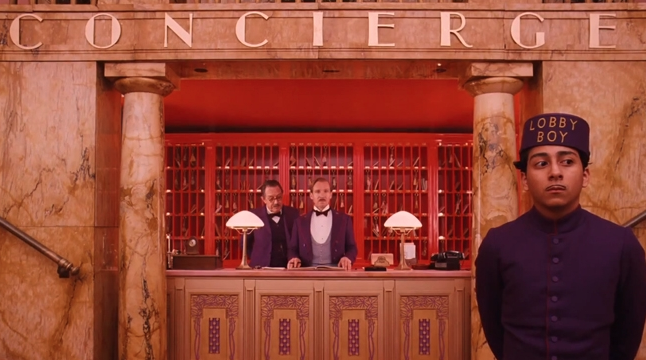
Wes Anderson’s The Grand Budapest Hotel owes a considerable debt (acknowledged in its closing credits) to the author Stefan Zweig and his remarkable portraits of Eastern Europe in the years before World War II. Although Zweig enjoyed immense popularity in the 1930s, his prominence faded in the years following the War. The New York Review of Books features an interesting essay by Anka Muhlstein on his life in exile once the Nazis began their march across Europe, and explores the possible motives behind his eventual suicide.
Drawing parallels between the author’s life and Anderson’s movie, Muhlstein writes:
Of all the characters in the film, it is unexpectedly the concierge—played by Ralph Fiennes in rare form, with a trim little paintbrush mustache, shifty eyes and a supple grace to his movements, comfortable mastery of all languages, a certain latitude in his sexual tastes, and an overall sense of calm broken here and there by glimmers of disquiet—who best evokes Zweig.
There’s much more at the link.
‘True Detective’ and Nihilistic Philosophy
March 3, 2014

Vulture has an interesting piece about the philosophical underpinnings of the HBO show “True Detective,” in which a nihilistic detective “Rust” Cohle (Matthew McConaughey) is paired with much more Everyman partner Marty Hart (Woody Harrelson) to track down a murderer (or murderers) in Louisiana over seventeen years. In a Q-and-A, author-and-academic Paul J. Ennis decided to take a stab at explaining Cohle’s mindset. To wit:
Nuances dividing these thinkers aside, I’d say philosophically Rust considers consciousness an aberration or evolutionary error/mistake, that he is not concerned with filtering knowledge according to “the pathetic twinge of human self-esteem” [to quote philosopher Ray Brassier], and that, as an anti-natalist, he subscribes to the old maxim of “better to have never been born.” Better yet, many of these thinkers argue, as Rust mentions, that we should stop reproducing in order to end the cycle of existence.
And so on. It’s not light reading, but it’s a more interesting diversion than most television-related interviews, and well worth checking out.
A Small Update on Ol’ Bill Shakespeare
August 20, 2013
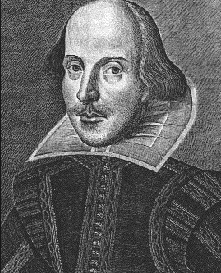 Maybe William Shakespeare isn’t the unique rose of English literature that everybody thought: new research suggests that the Bard didn’t invent all the terms (swagger, grovel, etc.) for which he’d been credited as creator.
How did a bunch of researchers arrive at this particular conclusion? They took a whole mess of English literature from Shakespeare’s era and ran it through a “computerized quantitative analysis,” according to a new story in the Boston Globe. Their findings: Shakespeare used pretty much the same language as his contemporaries, coining relatively few new words in the process.
But this research shouldn’t detract from an appreciation of Shakespeare’s work. “Knowing that Shakespeare did not invent as many words as we once thought or that his vocabulary was not much different from those of his fellow writers should in no way diminish our admiration for his artistry,” Russ McDonald, professor of English literature at Goldsmiths, University of London, wrote in an email to the newspaper. “Theatrical and literary history attests to his unparalleled use of the same materials as everybody else.”
Crazy as a Fox
May 9, 2013

“Mad, adj. Affected with a high degree of intellectual independence.” – Ambrose Bierce, famous for a.) his dry wit and b.) his mysterious disappearance into the chaos of the Mexican Revolution.
Taking Nerval’s Lobster for a Walk
March 6, 2013
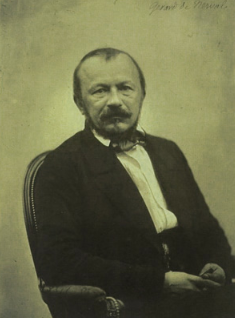
Boing Boing (is that an onamonapia?) recently offered up a rather interesting piece on the one and only Gérard de Nerval, who plays a somewhat-prominent role in How to Become an Intellectual. It discusses how the poet and essayist skittered along the jagged line of genius and madness (“To make matters worse, the lunacy that had tormented him all his life was back, scrabbling at the basement door of his mind.”) as well as his influence on other intellectuals and writers (“T.S. Eliot sampled him in his modernist mash-up The Waste Land.”) but spends much of its length talking about the man’s unusual choice of pets: a lobster that he sometimes walked around town on a leash of blue ribbon.
When confronted about this lifestyle choice, Nerval reportedly responded:
“Why should a lobster be any more ridiculous than a dog? Or a cat, or a gazelle, or a lion, or any other animal that one chooses to take for a walk? I have a liking for lobsters. They are peaceful, serious creatures. They know the secrets of the sea, they don’t bark, and they don’t gobble up your monadic privacy like dogs do. And Goethe had an aversion to dogs, and he wasn’t mad!”
But the article delves deeper: is it possible, in fact, to leash a crustacean and take it for a stroll on dry land, without causing the poor beast to expire? Scientists are divided, apparently, about the feasibility of such a thing. Lobsters can walk a bit in the open air, although “prolonged exposure to air” will eventually kill them (ambient temperature can also create a problem). All that being said, though, One scientist thought a short walk would be possible under certain conditions.
The whole article is well worth reading. Whether or not the lobster walk was true, or yet another embellishment of an already-weird life, Nerval was an interesting character.
Great Moments in Intellectual Discourse #8
January 19, 2013
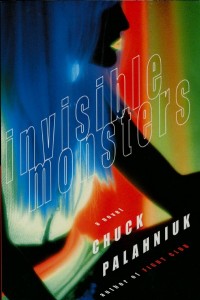 “Give me rampant intellectualism as a coping mechanism.”
– Chuck Palahniuk, in his novel Invisible Monsters.
The Secret to Revisions
January 11, 2013

As crime writers go, Raymond Chandler was rather cerebral. He didn’t write with the fevered intensity of Jim Thompson or Mickey Spillane. His fiction, which featured detective Philip Marlowe drifting around Los Angeles, didn’t feature the wall-to-wall gunfights or the twisted freaks that stuff most pulpy literature. But Chandler’s writing process was definitely a little tortured, at least based on this quote I found the other day:
“Throw up into your typewriter every morning. Clean up every noon.”
Or as someone else once memorably phrased it: write with your heart, re-rewrite with your head.
Yep, It’s the Holidays
November 27, 2012
Let’s put aside the fact that it’s Black Friday, or Cyber Monday, or Deal-of-the-Week Tuesday, or whatever. Simply stated, it’s the holidays, and you need a gift for that brainiac in your life—preferably something that involves words printed on pulped wood (or its digital equivalent). You could buy them a boxed set of Twilight novels, as a joke, but their heads might explode at the sight of it (and not in a good way). Or you could offer a copy of our modest tome, the only one—so far as we know—that combines Einstein, Shakespeare, the best recipes for ostrich brains, discussions of the space-time continuum, The Magic Flute, the ideal rules for bullshitting, and much more into one tasty package.
The Importance of Keeping Your Manets and Masaccios Straight
November 21, 2012
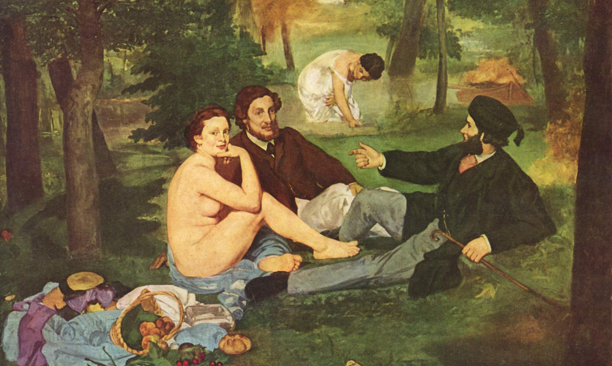
From The Huffington Post: a lighthearted bit on the art world’s biggest intellectual landmines.